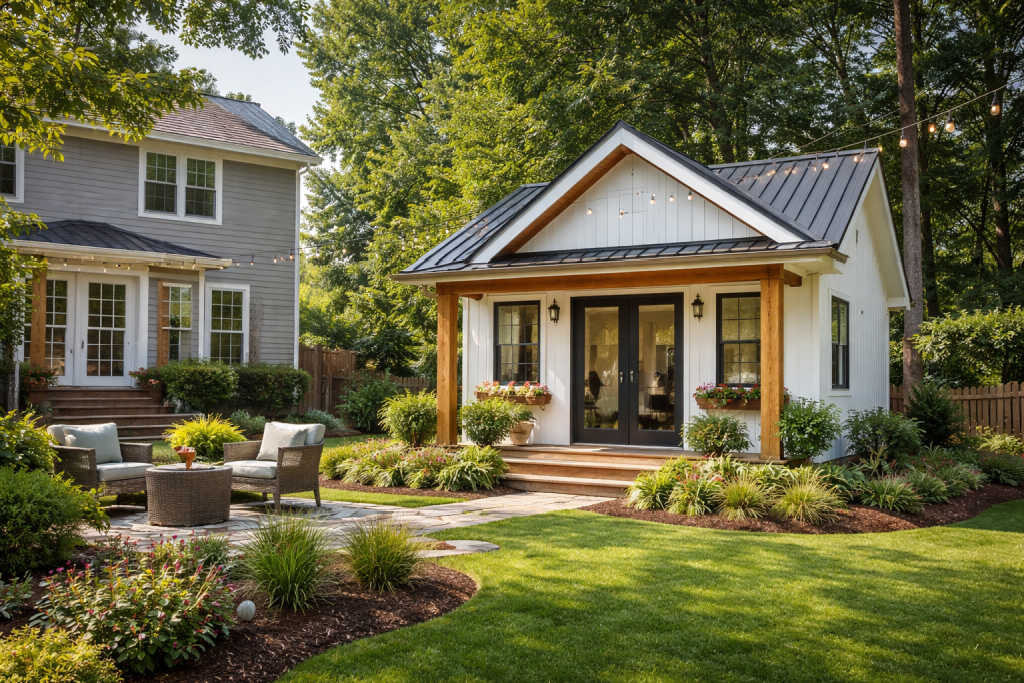
So, you’ve run out of space and you want to put an ADU in your backyard in Raleigh, NC!
Accessory Dwelling Units (ADUs) are popular options for people looking to expand their square footage or bring in extra income. Because, as we all know, housing affordability has continued to remain high.
The following information has been gathered from the various town websites. But, it is strongly recommended that you check with each municipality (links below) before building an ADU. Regulations can change and websites aren’t always up to date.
General Recommendations if your considering building an ADU in your backyard around Raleigh, NC:
- Verify Local Regulations: Contact your local planning department to determine if ADUs are permitted in your area and to understand specific requirements.
- Consult Homeowners Associations (HOAs): If your property is within an HOA, review any covenants or restrictions regarding ADUs, as they may have additional limitations.
- Stay Informed on Updates: Municipal regulations can change; staying informed about local policy discussions can provide insights into future ADU opportunities.
By understanding and adhering to local regulations, homeowners can effectively navigate the process of establishing an ADU in Wake County.
#1. ADU’s in Wake County NC
Basically, ADU’s are secondary housing units located on the same lot as a primary residence. And, yes, most municipalities want them to be in your backyard!
In Wake County, the regulations governing ADUs vary across different municipalities. Some towns permit them under specific conditions and others impose restrictions or prohibitions.
Wake County (Unincorporated Areas): In areas solely under Wake County’s jurisdiction, ADUs are allowed with certain requirements:
- The ADU must be subordinate to the primary dwelling and can be either attached or detached.
- It must function as an independent living facility, equipped with a kitchen, sanitation, and sleeping areas.
- At least one off-street parking space is required in addition to those for the primary dwelling.
- The size of the ADU should not exceed 50% of the gross floor area of the primary dwelling unit.
- Only one ADU is permitted per property.
- A manufactured home is allowable as an ADU only on a lot of at least 10 acres.
It’s recommended to verify your planning jurisdiction to ensure Wake County regulations apply to your property. If you live within one of the towns or cities in Wake County, their ordinances will apply. Wake County Government
#2. ADU’s in City of Raleigh NC
City of Raleigh: Raleigh permits ADUs in the following zoning districts:
- R-1,
- R-2,
- R-4
- R-6
- R-10
- RX
- OX
- NX
- DX
- CX
If you don’t know how your property is zoned, you can use the Wake County GIS or the Real Estate Records site to find out.
ADUs can be detached, attached, or internal to the primary dwelling and may be one or two stories. The city has streamlined the permitting process through the ADU Fast Track program, offering pre-reviewed building plans to facilitate construction. City of Raleigh
In 2020, Raleigh’s City Council approved an ordinance allowing ADUs across various zoning districts, aiming to increase affordable housing options. Indy Week
#3. ADU’s in Cary NC
The Town of Cary allows detached ADUs in the following zoning districts:
- Residential 80 (R-80),
- Residential 40 (R-40),
- Residential 20 (R-20),
- and certain Town Center districts.
Attached ADUs, referred to as Utility Dwelling Units (UDUs), are permitted in all residential zoning districts except Residential Multi-Family (RMF).
The ADU cannot exceed 33% of the heated square footage of the main dwelling or 800 square feet, whichever is smaller. Additionally, the combined floor area of all detached buildings on the lot cannot exceed 33% of the heated square footage of the main dwelling. Cary NC
As of October 2024, Cary’s Planning and Zoning Board reviewed a proposed amendment to broaden the locations where ADUs can be constructed, aligning with the Cary 2040 Community Plan. Cary NC
#4. ADU’s in Apex NC
In Apex, North Carolina, Accessory Dwelling Units (ADUs), referred to as “Accessory Apartments,” are permitted under specific conditions. These are outlined in the town’s Unified Development Ordinance (UDO). Apex NC
Key Regulations for Accessory Apartments in Apex:
- Number Allowed: Only one accessory apartment is permitted per single-family dwelling unit.
- Size Restrictions:
- Attached Accessory Apartments: No explicit size limit is specified.
- Detached Accessory Apartments:
- Outside the Small Town Character Overlay District: Maximum size is 40% of the heated square footage of the principal dwelling.
- Within the Small Town Character Overlay District: Maximum size is the lesser of 50% of the heated square footage of the principal dwelling or 1,000 square feet.
- Design Consistency: The accessory apartment must be constructed with materials substantially similar to those of the principal dwelling to ensure architectural harmony.
- Compatibility: The accessory apartment should be compatible in character and subordinate in size to the principal dwelling unit.
- Setback Requirements: Attached accessory apartments must adhere to the minimum yard setbacks applicable to the district. Detached units must comply with the standards for detached accessory structures as specified in Section 5.2.7 of the UDO.
- Ownership: In residential districts, the accessory apartment must remain accessory to, and under the same ownership, as the principal single-family dwelling unit.
These regulations maintain the residential character of neighborhoods while providing flexibility for property owners to add secondary dwelling units.
For detailed information and any updates to these regulations, it’s advisable to consult the Town of Apex’s Unified Development Ordinance or contact the Planning Department directly. Apex NC
#5. ADU’s in Holly Springs NC
Holly Springs, North Carolina, recognizes Accessory Dwelling Units (ADUs) as secondary residential units located on the same lot as a primary dwelling.
The town’s Unified Development Ordinance (UDO) provides specific guidelines for the construction and use of ADUs, referred to as “Accessory Apartments.”
- Definition: An Accessory Dwelling Unit (ADU) is defined as “a second Dwelling Unit contained within, added onto, or contained on the same Lot as an existing Dwelling Unit, and which is clearly subordinate to the primary Dwelling Unit.” This includes rooms for rent in the primary dwelling, units in a guest house, carriage houses, pool houses, and units above or beside a garage. Holly Springs
- Permitted Use: According to the UDO’s Use Table (Table 3.2-A), Accessory Apartments are designated as an “Accessory Use” (A) in various residential districts, including RR (Rural Residential), SR (Suburban Residential), NR (Neighborhood Residential), and NCR (Neighborhood Center Residential). As an accessory use, ADUs are permitted only in conjunction with a primary residential use. Holly Springs
Additional Standards:
The UDO specifies that Accessory Apartments are allowed as accessory uses in certain districts, however it does not provide detailed additional standards within the provided sections. However, general provisions for an ADU in your backyard and how it may be used include:
- Location: Detached accessory buildings, such as ADUs, are not permitted in the front yard. Holly Springs
- Size Limitations: The total square footage of all detached accessory buildings on a lot should not exceed 50% of the finished floor area of the primary dwelling. For lots greater than two acres in the RR District, this limit increases to 100%. Holly Springs
- Number of Units: In residential districts other than RR, a maximum of two detached accessory buildings are allowed per lot. Holly Springs
Permitting Process: All accessory structures, including ADUs, require a permit from the Development Services Department. Submit your applications through the Holly Springs CityView Portal. The specific application type depends on the size and attachment of the structure:
- For detached structures less than 12 feet in any direction, use the “UDO Permit Application (Building Permit Not Required).”
- For structures larger than 12 feet in any direction or attached to the primary dwelling, use the “Building Construction – Residential” application.
A plot plan showing measurements from the proposed structure to property lines is required for all permits. Additional documents, such as building plans and impervious surface calculations, may be necessary depending on the project’s specifics. Holly Springs
Recommendations:
- Consult the UDO: Review the Holly Springs Unified Development Ordinance for comprehensive regulations regarding ADUs.
Holly Springs - Contact Development Services: For detailed information and guidance, reach out to the Holly Springs Development Services Department.
- Check HOA Regulations: If your property is within a Homeowners Association, ensure compliance with any additional covenants or restrictions related to accessory structures.
By adhering to these guidelines and consulting with local authorities, homeowners in Holly Springs can effectively plan and construct Accessory Dwelling Units in compliance with town regulations.
#6. ADU’s in Fuquay Varina NC
In Fuquay-Varina, North Carolina, Accessory Dwelling Units (ADUs), referred to as “Accessory Apartments,” are permitted under specific conditions as outlined in the town’s Land Development Ordinance (LDO).
Definition: An Accessory Apartment is a secondary dwelling unit located on the same lot as a principal single-family dwelling. It can be attached to or detached from the main residence and is intended to provide additional living space that is subordinate to the primary dwelling.
Permitted Zoning Districts: Accessory Apartments are allowed as accessory uses in various residential zoning districts, including:
- Residential Low Density (RLD)
- Residential Medium Density (RMD)
- Residential Mixed-Use (RMU)
- Other applicable residential zones as specified in the LDO
General Standards:
So, if you want an ADU in your backyard in Fuquay-Varina (just southwest of Raleigh NC), there are a few basic things to consider.
- Number of Units: A maximum of one Accessory Apartment is permitted per single-family dwelling unit.
- Size Limitations: The total square footage of all accessory structures, including the Accessory Apartment, shall not exceed 10% of the total lot area for lots less than one acre. For lots one acre or greater, the limit is 5% of the total lot area.
- Setbacks: Accessory structures must adhere to minimum setback requirements, typically an eight-foot setback from property lines. Specific setback standards are detailed in Section 9-1302 of the LDO.
- Use Restrictions: Accessory Apartments shall not be used for commercial purposes or as home occupations. They cannot be rented, leased, or sold separately from the principal dwelling.
Permitting Process: All Accessory Apartments require a building permit, regardless of size, to ensure compliance with zoning regulations and proper anchoring to the ground. The Town’s Inspections Department facilitates this permitting process.
Additional Considerations:
- Historic Districts: Properties located within historic preservation districts may have additional regulations or restrictions.
- Homeowners Associations (HOAs): If your property is within an HOA, review any covenants or restrictions regarding Accessory Apartments, as they may impose additional limitations.
Recommendations:
- Consult the LDO: Review the Town of Fuquay-Varina’s Land Development Ordinance for comprehensive regulations regarding Accessory Apartments.
- Contact the Planning Department: For detailed information and guidance, reach out to the Fuquay-Varina Planning Department at (919) 552-1429 or planning@fuquay-varina.org.
- Verify Property Eligibility: Ensure your property meets the zoning and lot size requirements for adding an Accessory Apartment.
By adhering to these guidelines and consulting with local authorities, homeowners in Fuquay-Varina can effectively plan and construct Accessory Apartments in compliance with town regulations.